
The AI Confusion
If you’ve been following our AI journey, you’ve learned about artificial intelligence basics and explored machine learning applications. Now comes a question that confuses many people: What’s the difference between machine learning vs. deep learning? Are they the same thing? Which one is better?
These terms are often used interchangeably in news articles and business discussions, but they represent different approaches to artificial intelligence. Understanding this distinction is crucial as we move deeper into 2025, where both technologies are reshaping industries across Australia, the United States, China, and India.
Affiliate Disclosure: This post may contain affiliate links, which means I may receive a commission if you click on a link and purchase something that I have recommended. This comes at no additional cost to you, but helps support this blog so I can continue providing valuable AI insights. I only recommend products I believe in. Thank you for your support!
What Is Machine Learning?
As we covered in our previous posts, machine learning is a subset of artificial intelligence that enables computers to learn from data without being explicitly programmed for every task. Think of it as teaching a computer to recognize patterns and make decisions based on examples.
Traditional machine learning includes techniques like:
- Decision trees that make choices based on a series of yes/no questions
- Linear regression that finds relationships between different variables
- Support vector machines that classify data by drawing boundaries between different groups
- Random forests that combine multiple decision trees for better accuracy
These methods have powered many successful applications, from email spam filters to recommendation systems, and continue to solve numerous business problems effectively.
What Is Deep Learning?
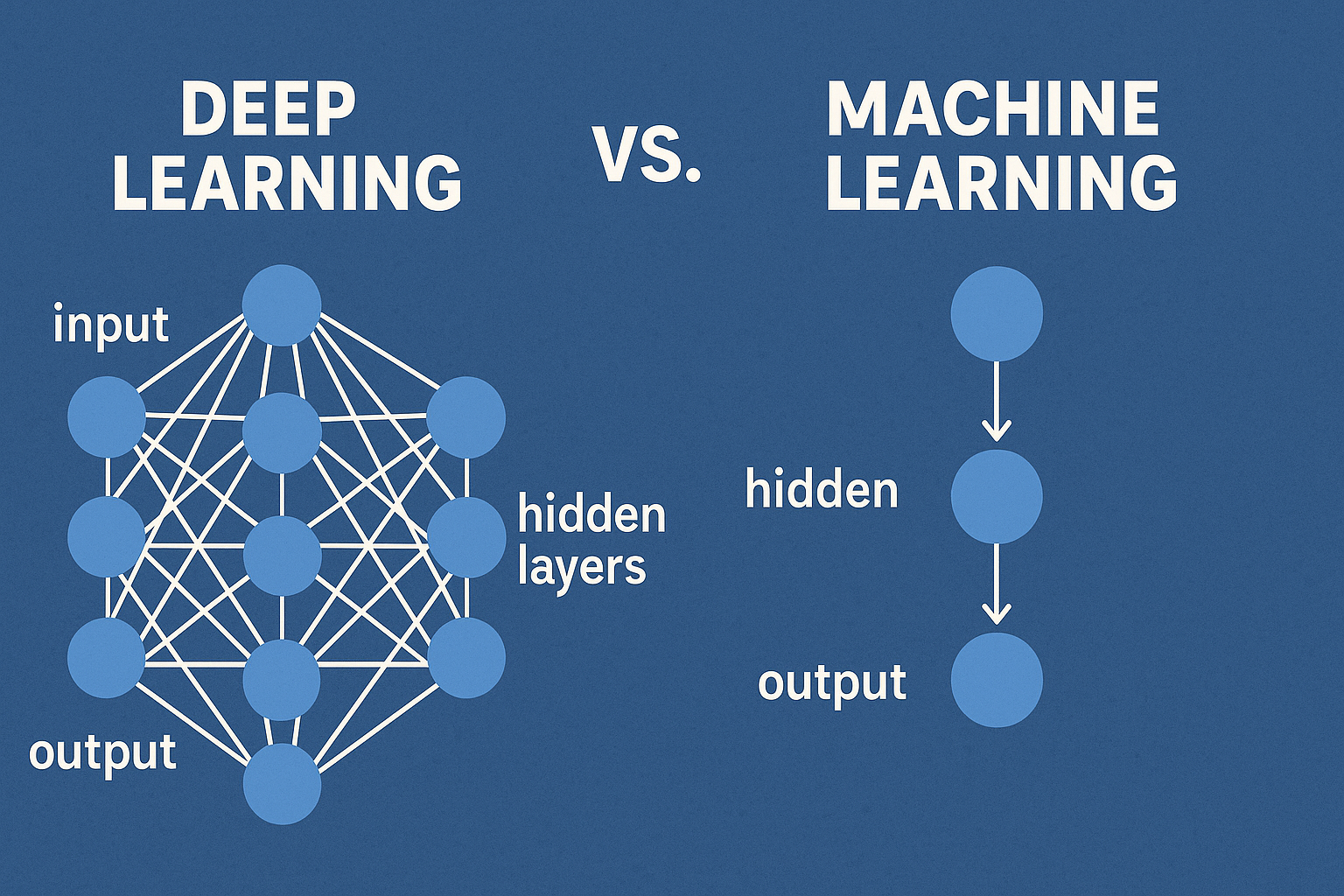
Deep learning is actually a specialized subset of machine learning, but it works very differently from traditional ML approaches. The “deep” in deep learning refers to neural networks with many layers—sometimes dozens or even hundreds of layers.
The Neural Network Foundation
Deep learning is built on artificial neural networks inspired by how our brains work. Just as our brains have billions of interconnected neurons that process information, artificial neural networks have interconnected nodes (artificial neurons) that process data.
A Simple Neural Network Example: Imagine you’re teaching a computer to recognize cats in photos. A traditional machine learning approach might require you to manually define features like “pointy ears,” “whiskers,” and “four legs.” The algorithm would then look for these predefined features.
Deep learning takes a different approach. You show the neural network thousands of cat photos, and it automatically discovers what features matter—including ones you might never have thought of. The network might learn to recognize subtle patterns in fur texture, eye shape, or even the way cats typically position themselves.
Why “Deep” Matters
The “depth” in deep learning comes from having multiple layers of artificial neurons:
- Input layer: Receives raw data (like pixels in an image)
- Hidden layers: Process and transform the data (there can be many of these)
- Output layer: Produces the final result (like “this is a cat”)
Each layer learns to recognize increasingly complex patterns. In image recognition:
- First layers might detect edges and shapes
- Middle layers might recognise textures and parts (like ears or eyes)
- Final layers combine everything to identify complete objects
Key Differences Between Machine Learning and Deep Learning
1. Data Requirements
Traditional Machine Learning:
- Can work effectively with smaller datasets (hundreds to thousands of examples)
- Often performs well with structured data (like spreadsheets)
- Requires less computational power to train
Deep Learning:
- Typically requires large datasets (thousands to millions of examples)
- Excels with unstructured data (images, audio, text)
- Needs significant computational power, often requiring specialized hardware
2. Feature Engineering
Traditional Machine Learning:
- Requires human experts to identify and create relevant features
- Data scientists must understand the problem domain deeply
- Features are manually selected and engineered
Deep Learning:
- Automatically discovers relevant features from raw data
- Reduces the need for domain expertise in feature selection
- Can find patterns humans might miss
3. Interpretability
Traditional Machine Learning:
- Generally more interpretable and explainable
- Easier to understand why a decision was made
- Better for regulated industries requiring transparency
Deep Learning:
- Often works as a “black box”
- Difficult to explain specific decisions
- Growing field of “explainable AI” trying to address this challenge
4. Training Time and Resources
Traditional Machine Learning:
- Faster to train and implement
- Runs on standard computer hardware
- Lower computational costs
Deep Learning:
- Longer training times (hours to weeks)
- Often requires specialized hardware (GPUs, TPUs)
- Higher computational and energy costs
Real-World Applications: Where Each Excels
Traditional Machine Learning Success Stories
Netflix Recommendations (Traditional ML): Netflix’s original recommendation system used collaborative filtering and matrix factorisation—traditional ML techniques. These methods analyse user behavior patterns to suggest content, and they work extremely well for this structured data problem.
Credit Scoring in India: Companies like Lendingkart use traditional machine learning algorithms to assess credit risk for small businesses. They analsze structured data like financial records, payment histories, and business metrics. Traditional ML is perfect here because the relationships are relatively straightforward, and the results need to be explainable to regulators.
Australian Agriculture Optimisation: Precision agriculture companies in Australia use traditional ML to optimise crop yields. They analyse structured data from sensors measuring soil moisture, temperature, and nutrient levels. Linear regression and decision tree models effectively predict optimal planting and harvesting times.
Deep Learning Breakthroughs
Medical Imaging Revolution: Google’s deep learning system for diabetic retinopathy detection uses convolutional neural networks to analyse retinal photographs. The system has been deployed in India and Thailand, where it helps identify diabetic eye disease with over 90% accuracy—matching specialist doctors.
Traditional machine learning would struggle with this task because manually defining features in medical images is extremely difficult. Deep learning automatically learns to recognise subtle patterns that even trained doctors might miss.
Autonomous Vehicles in China: Baidu’s Apollo autonomous driving platform uses deep learning to process real-time camera, radar, and sensor data. The system must instantly recognize pedestrians, vehicles, road signs, and traffic patterns in complex urban environments.
This application requires deep learning because:
- The data is highly unstructured (visual and sensor information)
- Decisions must be made in milliseconds
- The environment is constantly changing and unpredictable
Voice Assistants Worldwide: Amazon’s Alexa, Google Assistant, and Apple’s Siri all rely heavily on deep learning for speech recognition and natural language understanding. These systems must process audio waves, convert them to text, understand meaning, and generate appropriate responses—all tasks where deep learning excels.
Industry Implementation Patterns Across Our Target Markets
United States: Research and Innovation Focus
American companies tend to lead in deep learning research and development, particularly in:
- Healthcare AI: Companies like IBM Watson Health use deep learning for medical diagnosis
- Autonomous systems: Tesla, Waymo, and others pioneer self-driving technology
- Natural language processing: OpenAI, Google, and Microsoft advance conversational AI
Traditional ML remains strong in:
- Financial services: Credit scoring, fraud detection, algorithmic trading
- E-commerce: Recommendation systems, pricing optimisation
- Supply chain: Demand forecasting, inventory management
China: Manufacturing and Scale Implementation
Chinese businesses excel at implementing both technologies at massive scale:
- Deep learning dominance: Facial recognition systems, smart city surveillance, autonomous manufacturing
- Traditional ML strength: E-commerce recommendations, logistics optimisation, financial risk assessment
Example: Ant Financial (now Ant Group) uses traditional ML for credit scoring and fraud detection, but deep learning for voice payments and customer service chatbots. They choose the right tool for each specific problem.
Australia: Resource and Environmental Applications
Australian companies leverage both approaches for unique challenges:
- Traditional ML: Mining optimization, agricultural forecasting, energy grid management
- Deep learning: Environmental monitoring, species identification, geological surveys
Example: The Great Barrier Reef Marine Park Authority uses traditional ML to analyze water quality data but employs deep learning to automatically count and classify marine species from underwater camera footage.
India: Cost-Effective Solutions and Healthcare
Indian businesses often favor traditional ML for cost-effectiveness but are rapidly adopting deep learning where it provides clear advantages:
- Traditional ML dominance: Financial inclusion, telecom optimisation, basic e-commerce
- Growing deep learning adoption: Medical diagnosis, agricultural imaging, multilingual processing
Example: Practo, India’s largest healthcare platform, uses traditional ML for appointment scheduling and basic symptom checking but implements deep learning for medical image analysis and multilingual patient communication.
When to Choose Which Approach
Choose Traditional Machine Learning When:
- You have structured, tabular data (like spreadsheets or databases)
- Your dataset is relatively small (less than 100,000 examples)
- You need explainable results (for regulatory compliance or business understanding)
- You have limited computational resources
- The problem has well-understood patterns (like financial forecasting)
Perfect Example: A small Australian retail business wanting to predict which products to stock based on historical sales data, weather patterns, and local events.
Choose Deep Learning When:
- You’re working with unstructured data (images, audio, text, video)
- You have large datasets (hundreds of thousands to millions of examples)
- Traditional methods have reached their performance limits
- You can accept “black box” decision-making
- You have access to significant computational resources
Perfect Example: A Chinese smartphone manufacturer wanting to implement real-time language translation that works with speech, text, and even signs captured by the camera.
The Hybrid Approach: Best of Both Worlds
Many modern applications combine both traditional machine learning and deep learning to achieve optimal results.
Spotify’s Music Recommendation:
- Traditional ML: Analyses structured data like listening history, user demographics, and song metadata
- Deep learning: Processes audio signals to understand musical characteristics and mood
- Combined result: More accurate and diverse music recommendations
Uber’s Ride Optimization:
- Traditional ML: Predicts demand patterns and optimises pricing based on historical data
- Deep learning: Processes real-time traffic images and GPS data for route optimisation
- Combined result: Faster rides and better pricing
Common Misconceptions
“Deep Learning Is Always Better”
This is false. Deep learning excels with unstructured data and complex patterns, but traditional ML often performs better with structured data and smaller datasets while being more efficient and interpretable.
“Traditional Machine Learning Is Outdated”
Traditional ML remains crucial for many business applications. Netflix still uses collaborative filtering, banks rely on logistic regression for credit decisions, and most business forecasting uses traditional time-series analysis.
“You Need a PhD to Use Deep Learning”
While deep learning can be complex, modern tools and cloud services make it accessible to non experts. Platforms like Google’s AutoML and Amazon’s SageMaker provide user-friendly interfaces for deep learning implementation.
The Future: Evolution, Not Revolution
Looking ahead in the future, we’re seeing:
Automated Machine Learning (AutoML)
Tools that automatically choose between traditional ML and deep learning based on your data and problem type. This makes both approaches more accessible to businesses without extensive AI expertise.
Efficient Deep Learning
New techniques are making deep learning more efficient and capable of running on smaller datasets and less powerful hardware, blurring some traditional distinctions.
Explainable AI
Research is making deep learning more interpretable, addressing one of traditional ML’s key advantages.
Practical Getting Started Advice
For Business Leaders:
- Start with your data: Structured data often works well with traditional ML; unstructured data usually requires deep learning
- Consider your resources: Traditional ML is cheaper to implement and maintain
- Think about explainability: Regulated industries often need traditional ML’s transparency
For Technical Teams:
- Try traditional ML first: It’s often simpler and may solve your problem effectively
- Experiment with both: Use tools like Python’s scikit-learn for traditional ML and TensorFlow/PyTorch for deep learning
- Start small: Pilot projects help you understand which approach works better for your specific use case
The Right Tool for the Right Job
The difference between machine learning and deep learning isn not about one being better than the other. It’s about using the right tool for the right job. Traditional machine learning remains powerful, efficient, and interpretable for many business applications, while deep learning excels at complex pattern recognition in unstructured data.
As businesses across Australia, the United States, China, and India continue their digital transformation journeys, success comes from understanding these differences and applying each technology where it provides the greatest advantage.
Whether you’re analyzing customer purchase patterns with traditional ML or implementing computer vision with deep learning, the key is matching the technology to your specific problem, data, and constraints.
Keywords: deep learning vs machine learning, neural networks, artificial intelligence comparison, AI implementation, machine learning applications, deep learning applications, business AI strategy, ML vs DL, artificial neural networks, AI technology guide